FBR Circular Clause 11: Digital Integration, 10% Tax Credit & 3% Expenditure Disallowance
Supply chain context · Wise Supply Chain
The 10% credit and 3% disallowance apply to in-scope businesses whether you run a standalone invoicing tool or a full operations stack. On Wise Supply Chain, Digital Invoice posts the same sales invoices your warehouse and purchasing already use—so “acting as an integrated enterprise” is one document trail, not a second catalog.
Clause 11 of the FBR circular: 10% tax credit for digital integration and 3% expenditure disallowance if you fail to act as an integrated enterprise—plus why distributors and manufacturers should connect stock, sales, and FBR posting on one Wise Supply Chain spine.
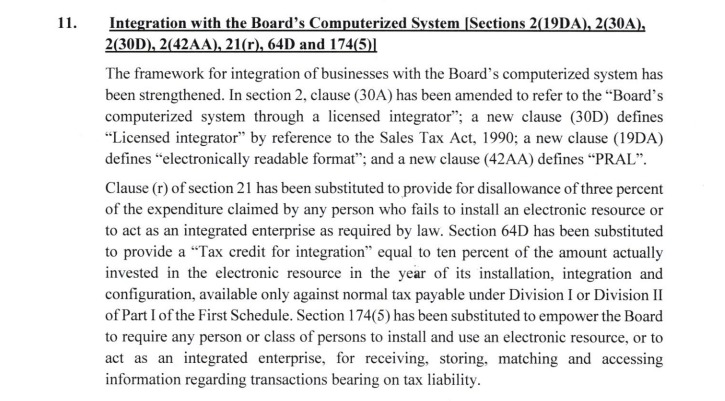
If you buy, store, make, and sell goods in Pakistan, Clause 11 of the FBR circular is not only a tax-IT memo. It treats digital integration as part of how you run the business: a 10% tax credit on eligible electronic-resource investment, and a 3% disallowance of claimed expenditure if you do not install the required system or act as an integrated enterprise. For distributors and manufacturers, that 3% lands on a large cost base—so staying unintegrated is a margin problem, not a paperwork delay. This article explains the circular in everyday language, why integration now matters more than a PDF invoice, and how Wise Supply Chain helps you get there. For how posting actually works, see FBR digital invoicing in Pakistan and what FBR digital invoicing is.
What Clause 11 says, in plain English
The heading is Integration with the Board’s Computerized System (Sections 2(19DA), 2(30A), 2(30D), 2(42AA), 21(r), 64D and 174(5)). In simple terms, FBR is tightening three ideas:
- Who connects, and how. The law now talks about connecting to the Board’s computerized system through a licensed integrator, using an electronically readable format, with PRAL named in the definitions.
- A carrot. Section 64D gives a tax credit for integration equal to 10% of what you actually invested in the electronic resource, in the year you install, integrate, and configure it.
- A stick. Section 21(r) can disallow 3% of the expenditure you claimed if you fail to install that electronic resource or fail to act as an integrated enterprise as required by law.
Section 174(5) also lets the Board require a person or class of persons to install and use an electronic resource, or to act as an integrated enterprise, so FBR can receive, store, match, and access information about transactions that affect tax liability. That is the policy point: FBR wants a live, matchable trail—not a folder of unofficial PDFs at return time.
Why digital integration is important now
“Integration” here does not mean emailing a scanned invoice. It means your sales (and, where notified, related records) sit in a system FBR can read and match: structured invoices, validated buyers, and posting through an approved channel. Manual files can still go to customers for readability; the compliance record is the electronic one. That is what digital invoice software in Pakistan and FBR API integration are built to do.
For a distributor or manufacturer, the same rule sits on top of purchasing and stock. If GRNs, warehouse balances, and sales invoices already share one catalog, FBR posting is the last mile of that spine—not a second invoicing tool that re-keys what the godown already shipped. See supply chain with FBR digital invoicing and the purchase-to-FBR flow.
Delay has two price tags at once: you may miss the 10% credit on the year you actually spend, and you may keep paying the 3% expenditure hit until you integrate. Fines and sealing under other digital-invoicing rules (see our Budget 2026–27 penalties article) sit alongside this income-tax treatment—they are not a substitute for it.
The benefit — 10% tax credit (Section 64D)
If you are required to integrate, and you actually spend on eligible electronic resources (hardware, software, installation, and configuration used to connect with FBR), you may claim a tax credit equal to ten percent of that investment in the same tax year the resource is installed, integrated, and configured.
Simple example: you spend Rs 1,000,000 on eligible integration kit and go-live in that year → credit of Rs 100,000 against normal tax (Division I or II of Part I of the First Schedule)—not a blank cheque against every other levy. Recurring running costs after go-live typically do not count. Confirm eligibility with your tax adviser.
How the 10% credit actually helps
Think of the credit as FBR sharing a slice of the one-time cost of getting onto the system. It is designed to pull businesses over the “we will do it next year” line:
- It is a credit, not only a deduction. A 10% credit reduces tax payable more directly than writing the same spend off as an ordinary expense.
- Timing matters. The circular says the credit is available in the year of installation, integration, and configuration. Spend this year and go live next year, and you may lose the window—plan hardware, software, and FBR credentials as one project.
- It only offsets normal tax under the divisions named in the circular. If your liability sits elsewhere, the credit may not apply the way a brochure implies.
On Wise Supply Chain you can enable Digital Invoice alone, Supply Chain Management, or both. Eligible spend your adviser may discuss often includes POS or shop-floor devices, licensed-integrator connectivity where required, and software that actually posts. When SCM and Digital Invoice share one product and customer master, configuration is “sales that already moved stock,” not a parallel invoice book. Pair credentials from how to get FBR credentials with the 7-day trial (Digital Invoice, Supply Chain, or both).
The cost of delay — 3% expenditure disallowance (Section 21(r))
If you are required to install an electronic resource or to act as an integrated enterprise and you do not, Clause 11 provides for disallowance of three percent of the expenditure you claimed. Disallowance means that slice is treated as if it is not a deductible expense—so taxable income (and tax) can go up even when you “really spent the money.”
Simple example: you claimed Rs 10,000,000 of expenditure and you are not integrated as required → 3% = Rs 300,000 may be added back. That is a quiet, repeating hit—unlike a one-off fine you can pay and forget. Exact base and method can be prescribed by FBR; use this only as a scale illustration.
What the 3% disallowance feels like in a real business
Fines grab headlines. This rule is quieter and can be larger over a full year because it tracks expenditure you already claimed:
- It raises taxable profit on paper without a new customer or a better margin.
- It can repeat for as long as you remain outside the required integration.
- It stacks with other DI enforcement (monetary penalties, possible premises sealing, fake-invoice rules)—see who must use FBR digital invoicing.
Manufacturers and distributors usually have a large expenditure base (purchases, freight, wages, factory and godown costs). A 3% disallowance on that base is not a rounding error—it can dwarf the cost of putting sales on FBR from the same inventory spine. The operational fix is the same as the tax fix: one catalog, one sales invoice, FBR validate/submit on the document that already issued stock. Clean HS/UoM and buyer NTN in shared masters so validation errors are fixed once, not re-typed in a separate invoicing silo.
Licensed integrator, PRAL, and “electronically readable format”
Clause 11 also updates definitions so the legal text matches how FBR actually runs digital invoicing:
- Licensed integrator — a regulated bridge to the Board’s computerized system (as referenced from the Sales Tax Act, 1990). Software you use still has to post in the format FBR accepts; the integrator is not a replacement for clean invoices.
- Electronically readable format — structured data FBR can store and match, not a photograph of a handwritten bill.
- PRAL — named in the clause so the technology operator of FBR systems is part of the legal picture, not only an informal acronym on a login page.
You do not need to memorise section numbers to act. You do need a path from “we raised a sale” to “FBR accepted a structured invoice.” That path is credentials, validation, and posting—walked through in how to integrate the FBR API step by step.
What to do this month (credit in, disallowance out)
Treat Clause 11 as a two-sided budget item: claim the credit in the year you go live, and stop the 3% leak.
- Confirm with your tax adviser whether you are a person (or class) required to install an electronic resource or act as an integrated enterprise—and which circular / SRO applies to your NTN.
- Bundle spend + go-live in the same tax year if you want the 10% credit discussion to be realistic: devices, software, licensed-integrator steps, and FBR sandbox → production.
- Clean customers (NTN/CNIC, province, registration type) and products (HS code, UoM). Import via the official Sales_Invoice_Template (.xlsm) if you are migrating from spreadsheets.
- If you also run purchasing and stock, align the same SKU and buyer masters across GRNs, inventory, and sales before you scale FBR posting—see supply chain software in Pakistan.
- Prove one clean sale end to end in sandbox: stocked SKU → sales invoice → validate → submit.
- Keep evidence of installation, integration, and configuration dates for the credit file your adviser will want.
Get integrated on Wise Supply Chain
Wise Supply Chain lets you run Digital Invoice on the same spine as purchasing, inventory, and accounting—or Digital Invoice alone if that is all you need this year. Validate and submit (including bulk validation and submission) sit on the sales invoices operations already use. Start a 7-day trial or request a free demo covering stock documents and a sandbox FBR post together.
This article is a plain-language summary of Clause 11 for general education. Section numbers, credit conditions, the expenditure base for the 3% disallowance, and who is required to integrate are defined by the official circular, the Income Tax Ordinance, SROs, and FBR prescriptions that can change. Confirm material points with a qualified tax adviser in Pakistan and publications on fbr.gov.pk before you file a return or claim a credit.
Get a free demo
See Wise Supply Chain on your use case: purchasing, inventory, payroll, accounting, and FBR validation in one walkthrough.
Request free demoNext steps (internal links)
Supply chain with FBR digital invoicing, supply chain software in Pakistan, FBR digital invoicing guide, FBR API integration, and free trial (7 days). Home · Contact us.